When community feedback contradicts itself
An adaptive survey that reads what people actually write, asks each person a tailored follow-up, and learns from everyone before them. How it tells real community disagreements from fake ones, with findings from a live deployment of 51 responses.
Two people fill in the same survey about the same patch of grass.
One writes: please don't do too much to it — it's so good to have a wild space on our doorstep. The other writes that it's an overgrown field nobody really uses, and someone should put a bike track in.
The same green drew two opposite verdicts. Now multiply that by fifty-one people and nine themes, and you have the problem every community survey eventually hands to whoever ordered it: a pile of suggestions that contradict each other, and no obvious way to tell which contradictions actually matter.
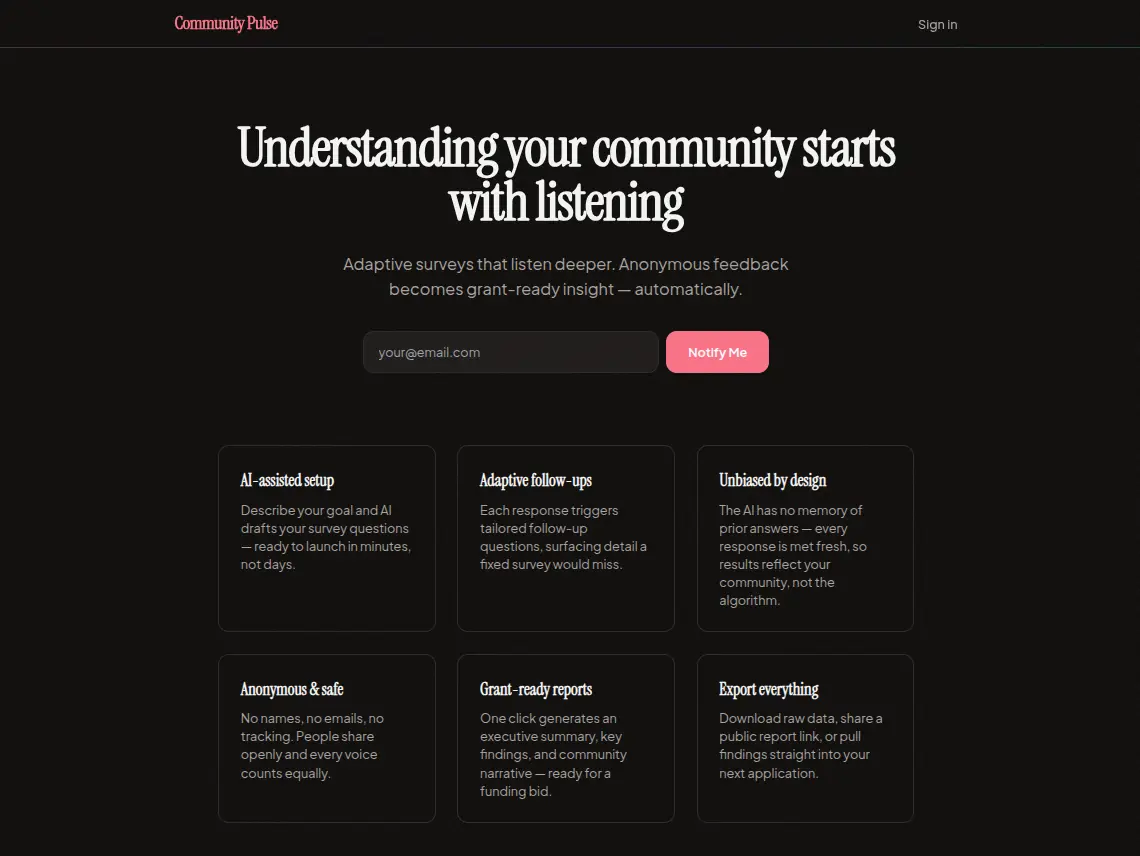
That pile is what Community Pulse was built to sort.
The trade-off every survey makes
If you've ever gathered opinions from a community, you've run into a frustrating choice. Surveys scale: send the same ten questions to a thousand people and compare the answers neatly. But they're rigid: everyone gets the same questions whether or not they fit, and the moment someone writes something unexpected in a free-text box, the form just records it and carries on. Interviews are the opposite. A good interviewer hears something interesting and follows it, asking why does that matter to you? But interviews don't scale, and the 31st person tells their story to someone who learned nothing from the first thirty.
Community Pulse tries to get both at once. You answer a few fixed questions, an AI model reads what you actually wrote, and it asks a follow-up tailored to your answer — automatically, for everyone. And it learns as it goes: as responses accumulate, it notices the themes people keep raising, including ones nobody designed the survey to ask about, and folds them into the questions later participants see. The 200th respondent answers a sharper survey than the 5th ever saw, not because a researcher redesigned it, but because 195 people quietly taught it what to ask.
But the headline isn't the adapting. It's what the adapting is for.
People suggest things. Things aren't the point.
When you ask people what they want from a shared space, they answer with concrete things: a fire pit, better lighting, a bike track, more bins. Call those objects. They're easy to picture, so they're what comes to mind.
But an object is only ever one way of meeting some underlying need. The person who asks for a fire pit might really want somewhere for people to gather on an evening, and if that's the real need, other things would meet it just as well. The fire pit was never the point; it was the first concrete thing to hand.
This matters because contradictions live almost entirely at the object layer. Drop down to the need underneath, and a pile of conflicting suggestions sorts itself into three very different kinds, and only one of them is a problem you can't dodge.
Three kinds of disagreement
Real conflict: the needs themselves clash. Take the wild-space camp and the bike-track camp from the opening. Probe underneath and one voice wanted somewhere quiet, unstructured, left largely alone; several wanted the opposite: somewhere active, used, alive with people. Those needs don't reconcile on the same patch of ground: you can't run a bike track through an undisturbed wildlife refuge. This is a genuine trade-off, and the useful thing the survey does is name it as one. The trustees aren't confused; they have a real decision to make about what the space is for. It's far better to see that clearly now than to discover it halfway through a project.
Fake conflict: different things, same need. Litter came up from seven people, each suggesting a different fix: more bins, children's anti-litter artwork, a habit of everyone picking up a piece per visit. It looks like disagreement, but it isn't. Everyone wanted the same thing, a clean and welcoming space, and merely guessed at different routes to it. When people share a need and differ only on method, the disagreement is cheap: pick whichever method works best. Nothing here needs agonising over.
Hidden conflict: same words, different needs. This is the sneaky one. Communication and transparency was one of the strongest themes: eight people, all using the same surface language about “information” and “transparency.” Read the headline count and the answer looks obvious — send a newsletter. But those eight wanted four different things: where the money goes; what the trustees are planning; public awareness that the green runs on volunteers at all; and more flexible ways to get involved. A newsletter satisfies part of one and quietly disappoints the rest. Here the agreement was the illusion, and the survey's job was to break it apart before anyone shipped the obvious fix.
There was a twist inside that theme, too. Around the 20th response it looked settled: nearly everything so far had been about money. A static survey closing then would have reported a clean mandate for financial transparency. Twenty responses later the strategy and public-awareness camps had appeared, and that “mandate” had shrunk to a minority view. The most confident-looking moment was the most misleading one.
How it decides where to dig
Telling those three apart is the whole game, and it's why a generic “anything else?” follow-up isn't enough: that just produces more objects. Instead, Community Pulse aims each follow-up at whatever is still unresolved about the theme a person just raised.
So when “communication” is visibly splitting into money, strategy, awareness, and participation, a new person who mentions it doesn't get a bland prompt; they get one built to reveal which of those four they mean. When someone offers a concrete object, the system nudges up a level — not “what else?” but “what's not working right now that makes this a priority?” — which surfaces the need behind the suggestion. And people who can name their need usually turn out to be flexible about how it's met. Occasionally it introduces a real constraint and watches what the person does with it: someone who pivots to a cheaper option that still works was attached to the outcome, not the method. That's something a plain wish-list can never tell you.
The point is that the direction of the dig isn't fixed; it's chosen, per person, by what the theme still needs to know.
Does it actually work?
The pilot ran for 57 days on a community-owned green space in London and collected 51 responses. Nine themes emerged, six of which weren't on the original questionnaire at all. People raised them in free text, and the system noticed the pattern and started treating them as first-class topics. A survey built only from the fixed questions would have missed most of what the community actually cared about.
And to check the adaptive follow-ups weren't just a nice story, each was judged head-to-head against one written by the same AI model with a strong but framework-free prompt. The “ask why” technique produced the better question 67% of the time it fired; the constraint technique, 88%. The biggest gains were in asking things the fixed survey couldn't, and in producing answers a decision-maker can actually use.
It's one park and fifty-one people: a start, not a proof. The next step is a proper A/B test: the full system on one side, a plain LLM-generated follow-up with none of the backend on the other, so the question stops being whether it helps and becomes how much it adds.
See it for yourself
Community Pulse is live
The platform is running real community surveys now. Try the adaptive questionnaire, read the build story, or — if you run community surveys yourself, or research adaptive instruments and want to compare notes — get in touch.